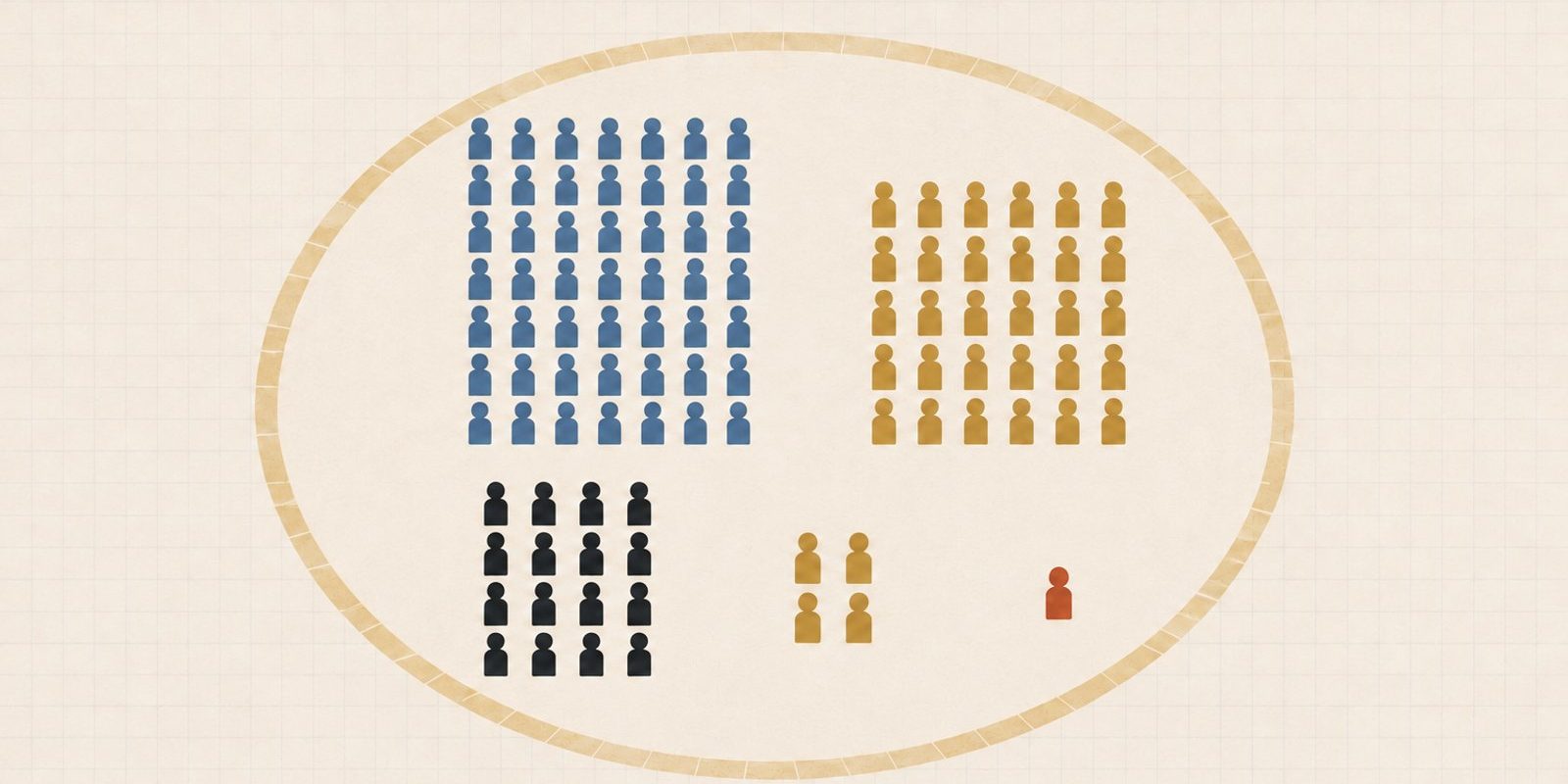
Picture a village square with exactly 100 people in it. Someone is selling bread. A kid on a bike weaves between the grown-ups. A grandmother watches from a bench.
Now say this square is the whole human race. In 2025 the UN counted about 8.23 billion people (UN WPP, 2024 revision). Divide by 100 and every villager stands for roughly 82 million real humans. Let’s look around the square.
Where the villagers live
Most of them came from one direction. Asia sends 59 of the 100. Africa sends 19. Everyone else is squeezed into the remaining 22 spots.
| Region (2025) | People in the village | Real population |
|---|---|---|
| Asia | 58.7 | 4.84 billion |
| Africa | 18.8 | 1.55 billion |
| Europe | 9.0 | 744 million |
| Latin America and Caribbean | 8.1 | 668 million |
| Northern America | 4.7 | 388 million |
| Oceania | 0.6 | 47 million |
Two countries alone fill 35 spots. India has about 17.8 villagers and China about 17.2 (UN WPP, 2025 estimates).
Ten countries, 57 villagers
The map gets even more lopsided if you count by country. The ten biggest countries in 2025 are India, China, the United States, Indonesia, Pakistan, Nigeria, Brazil, Bangladesh, Russia and Ethiopia. Together they hold about 57 of the 100 villagers (UN WPP, 2025 estimates). The United States has about 4 of them (4.2). The other 227 countries and areas in the UN’s list share the remaining 43.
So the typical villager is not American or European. If you reached into the square and picked one at random, the odds would favor someone from Asia, and the single likeliest nation would be India.
In a village of 100, all of Oceania would be about half a person.
thedigitbrew.com, from UN WPP 2024 data (our own line, not a quotation)
How old they are
Among the 100, about 24 are under 15. About 65 are between 15 and 64. About 10 are 65 or older (UN WPP, 2025). The three groups add to 99 because of rounding; the real figures are 24.4, 65.2 and 10.4. In real people, that is about 2.0 billion children under 15 and about 857 million adults aged 65 or older. Asia’s mix is close to the world’s: 22% under 15 and 10% aged 65 or older.
The square is split almost evenly between men and women: 50 men and 50 women (50.3 and 49.7, to be exact). The middle villager, with half the crowd older and half younger, is about 31 years old (UN WPP, 2025). A newborn in this village can expect to live about 73.5 years on average.
City, town or countryside
The UN’s 2025 urbanization report uses a satellite-based method that sorts places into cities, towns and rural areas. By that count, 45 villagers live in cities, 36 in towns and 19 in rural areas (UN DESA, 2025). Countries use their own definitions of “urban,” and by those the UN puts the world at 58% urban. The gap is a matter of definitions, not a mistake.
Who has the lights on
About 92 of the 100 have electricity at home. That leaves 8 in the dark. Those 8 stand for 666 million people in 2023 (World Bank and partners, Tracking SDG7, 2025). Roughly 7 of them live in sub-Saharan Africa, which holds 565 million of that total, or 85%. And 84% of everyone without power lives in rural areas.
Why the village flatters us
The neat picture hides three things.
First, the averages hide huge differences. The village’s “10 older adults” is really two villages. Europe is 21% aged 65 or older and 15% under 15. Africa is the reverse: 4% aged 65 or older and 39% under 15 (UN WPP, 2025).
| Per 100 people | Europe | Africa |
|---|---|---|
| Under 15 | 15 | 39 |
| Aged 65 or older | 21 | 4 |
Second, the years do not match. Population and age are for 2025, cities are for 2025, and electricity is for 2023, the latest year published. Mixing them is a rough sketch, not a snapshot.
Third, nobody agrees on the total to the last million. The Census Bureau projects 8.2 billion for July 2026 (US Census Bureau, 2026), while the UN’s 2026 estimate is 8.30 billion. Both are estimates, not head counts. Since each villager equals 82 million people, a single “person” can hide tens of millions of real lives.
The village is mostly Asian, mostly between 15 and 64, mostly living in a city or town, and almost entirely wired.
Sources
- UN DESA Population Division, “World Population Prospects 2024” (Medium variant, 2025 values for total population, region and age group), 2024. link
- US Census Bureau, “World Population Day: July 11, 2026”. link
- UN DESA, “Cities are home to 45 per cent of the global population” (World Urbanization Prospects 2025), November 2025. link
- World Bank, IEA, IRENA, UN, WHO, “Tracking SDG 7: The Energy Progress Report 2025”, 2025. link