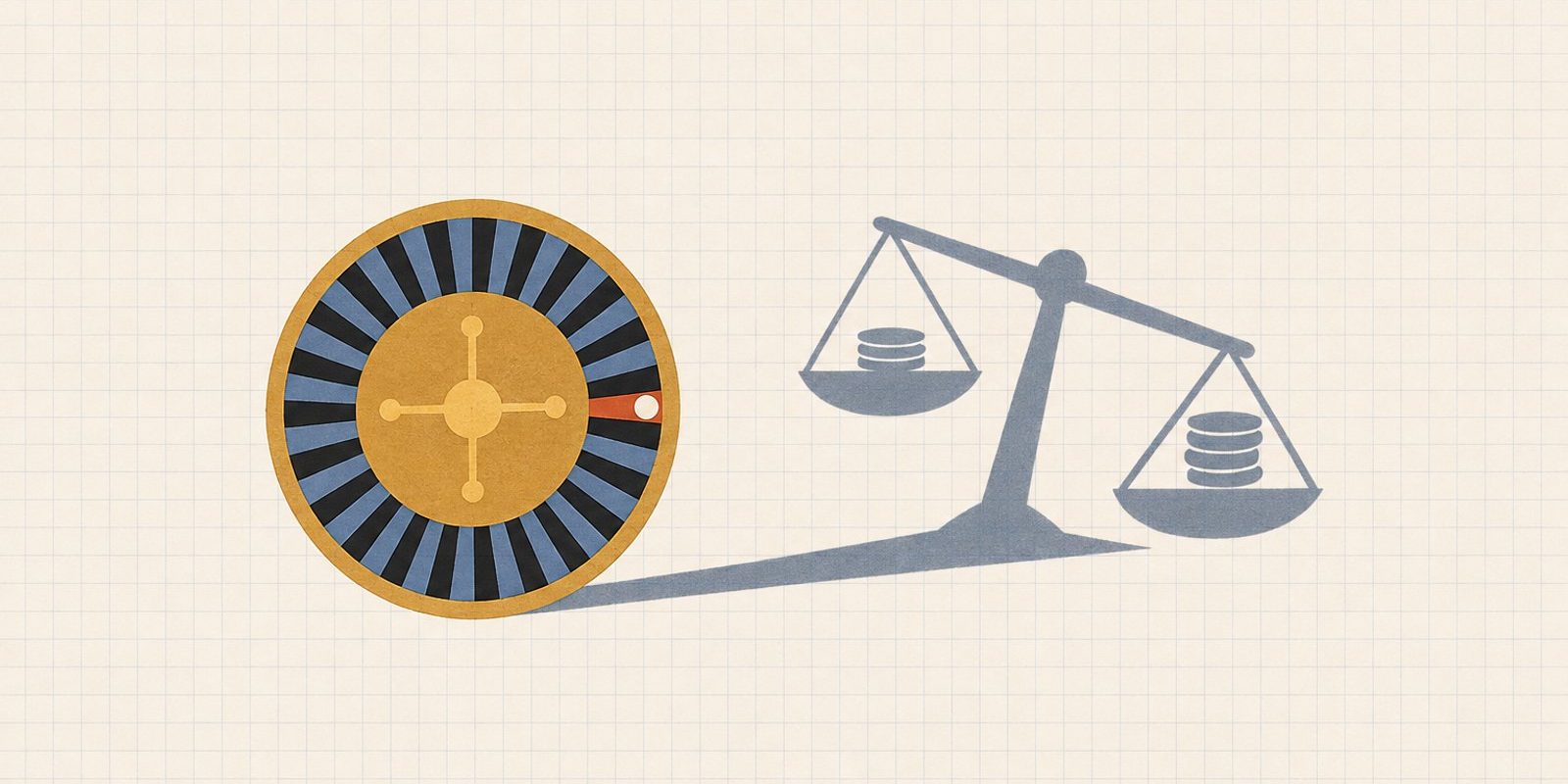
The wheel has landed on black five times in a row. A man at the table leans in and says, “Red is due.” It feels right. It feels like the universe keeping score.
It isn’t. The wheel is a spinning piece of metal with no memory, and the real score is kept by a different number, the one printed nowhere on the table: the house edge.
Where the edge comes from
An American roulette wheel has 38 pockets: the numbers 1 to 36, plus a 0 and a 00 (Wizard of Odds). A European wheel has 37, with just one zero. A winning single-number bet pays 35 to 1, which is what a fair game with 36 pockets would pay. The extra zero pockets are what tilt it.
On the American wheel, the house edge on almost every bet is 5.26 percent, or 1 in 19. On the European wheel it is 2.70 percent, or 1 in 37 (Wizard of Odds). One extra pocket roughly doubles the cost.
What that costs per $100
Take a $100 single-number bet. On the American wheel, you win $3,500 with probability 1 in 38 and lose $100 otherwise. The average comes out to a loss of $5.26. On the European wheel, 1 in 37, the average is a loss of $2.70.
That is the average over many bets, not what happens on any one spin. On one spin you either win big or lose $100.
| American (38 pockets) | European (37 pockets) | |
|---|---|---|
| House edge | 5.26% | 2.70% |
| Average loss per $100 wagered | $5.26 | $2.70 |
| Average loss on $100,000 wagered | $5,263 | $2,703 |
| Chance an even-money bet wins | 47.4% (18 in 38) | 48.6% (18 in 37) |
One oddity: the American wheel has a five-number bet (0, 00, 1, 2, 3) whose house edge is higher, 7.89 percent (Wizard of Odds).
The gambler’s fallacy
The famous example is Monte Carlo, August 1913. As the story is usually told, the ball landed on black 26 times in a row, and gamblers kept betting on red because red was “due.” Retellings say it cost them millions. The date and the count are repeated everywhere, but the original records are hard to find, so treat the details as a well-worn legend (University of Southern California Monte Carlo Fallacy project).
The math behind the story is solid. A run of 26 on one color on a single-zero wheel has odds of roughly 1 in 68 million (our calculation). It can happen. But the next spin is still the same coin-flip-with-a-twist. Each spin is independent. Past spins do not change the pockets.
The wheel does not remember. The house edge does not forget.
Why the house wins in the long run
Here is the part that surprises people. The house edge does not make you lose every time. It makes the long-run result predictable. Imagine betting $100 on red every spin of an American wheel. After 100 spins, you would expect to be down about $526, but the swing is so large that roughly 3 in 10 players end up ahead. After 1,000 spins you are down about $5,263 on average, and only about 5 in 100 are still ahead. After 10,000 spins, fewer than 1 in 10 million come out ahead. These percentages are our own estimates using a normal approximation.
That is the law of large numbers. Luck is the noise, which grows slowly, like the square root of the number of spins. The edge is the signal, which grows in a straight line. Over enough spins, the signal wins.
The twist: a small edge is still an edge
A 2.70 or 5.26 percent edge sounds tiny. It is not. The casino does not need to beat you on any spin. It needs only thousands of spins, from thousands of people, and the arithmetic does the rest. A bettor can win tonight, and the wheel can still be a machine for turning wagers into a steady fraction of revenue.
It also explains why the casino can smile at a lucky winner. One big payout is a rounding error against the flow of thousands of ordinary bets. The same logic runs the insurance business and every lottery: a small, steady margin applied to a very large number of trials.
The takeaway: roulette is not a game of streaks. It is a small, certain tax on every dollar that crosses the felt.
For illustration only. Not financial advice.